

Certification of Traceability System in the Food and Feed Chain
I. INTRODUCTION TO ISO 22005 CERTIFICATION SERVICESIn the context of an increasingly complex global food supply chain, the risks of food safety hazards, commercial fraud, and disease outbreaks have created an urgent need for traceability. Consumers, business partners, and regulatory bodies are increasingly demanding transparency regarding the origin, ingredients, and movement of products from farm to fork.
To meet this requirement, building an effective traceability system is a mandatory management tool. In essence, it is a mechanism that allows businesses to identify, collect, store, and link information related to the history, location, and movement of a product (or batch of raw materials) through each stage of the supply chain. Although this system does not directly prevent food safety hazards, it serves as the core foundation for quickly and accurately identifying the root cause of an issue, thereby enabling timely handling, isolation, and product recall measures.
ISO 22005 Traceability in the feed and food chain is an international standard that specifies the general principles and basic requirements for the design and implementation of a traceability system. The standard provides a technical framework that helps businesses:
- Clearly define traceability objectives (e.g., meeting regulatory requirements, supporting product recalls, or proving product authenticity).
- Record, track, and clearly identify the history and location of products or raw materials through each stage: from the receipt of raw materials, production, and processing, to packaging, storage, and distribution.
- Establish robust information links among relevant parties based on the "one step forward, one step back" principle (knowing exactly the immediate supplier of inputs and the immediate recipient of outputs).
Benefits of implementing and achieving ISO 22005 certification:
- Effective food safety control and risk management: In the event of a quality issue or food safety hazard, the system helps businesses quickly trace back to find the root cause and current location of the defective batch. This allows for precise and timely isolation and product recall, helping to minimize financial losses and public health risks.
- Enhanced transparency and brand protection: Demonstrating clear origins (from farm to fork) helps clearly delineate the responsibilities of each stakeholder. In the event of a PR crisis or complaint, traceability data is the most objective and concrete evidence to protect the business's reputation.
- Meeting legal requirements and overcoming trade barriers: Many countries and demanding export markets (such as the EU, US, and Japan) have strict legal regulations regarding traceability. ISO 22005 certification acts as a "passport" that helps businesses comply with the law, overcome technical barriers, and expand opportunities to enter international markets.
- Optimizing supply chain operations: Continuous tracking of material flow helps businesses manage inventory more scientifically and tightly control expiration dates, thereby minimizing waste (spoiled or expired materials) and improving internal operational efficiency.
- Increasing trust with consumers and partners: As consumers become increasingly sensitive and concerned about food origins, holding an ISO 22005 certification helps build solid trust, creating a distinct competitive advantage over market rivals.
- Easy integration with other management systems: ISO 22005 is flexibly designed, serving as a strong supplementary foundation that can be seamlessly integrated into comprehensive food safety management systems such as ISO 22000, HACCP, FSSC 22000, or BRC.
- Any business directly or indirectly involved in the food and feed supply chain, regardless of size (farms/livestock facilities, manufacturing/processing plants, packaging facilities).
- Entities specializing in food logistics, storage, preservation, and transportation services.
- Supermarkets, distributors, restaurants, and retail chains.
- Organizations seeking to standardize their data systems or upgrade their traceability capabilities within their current quality and food safety management systems.
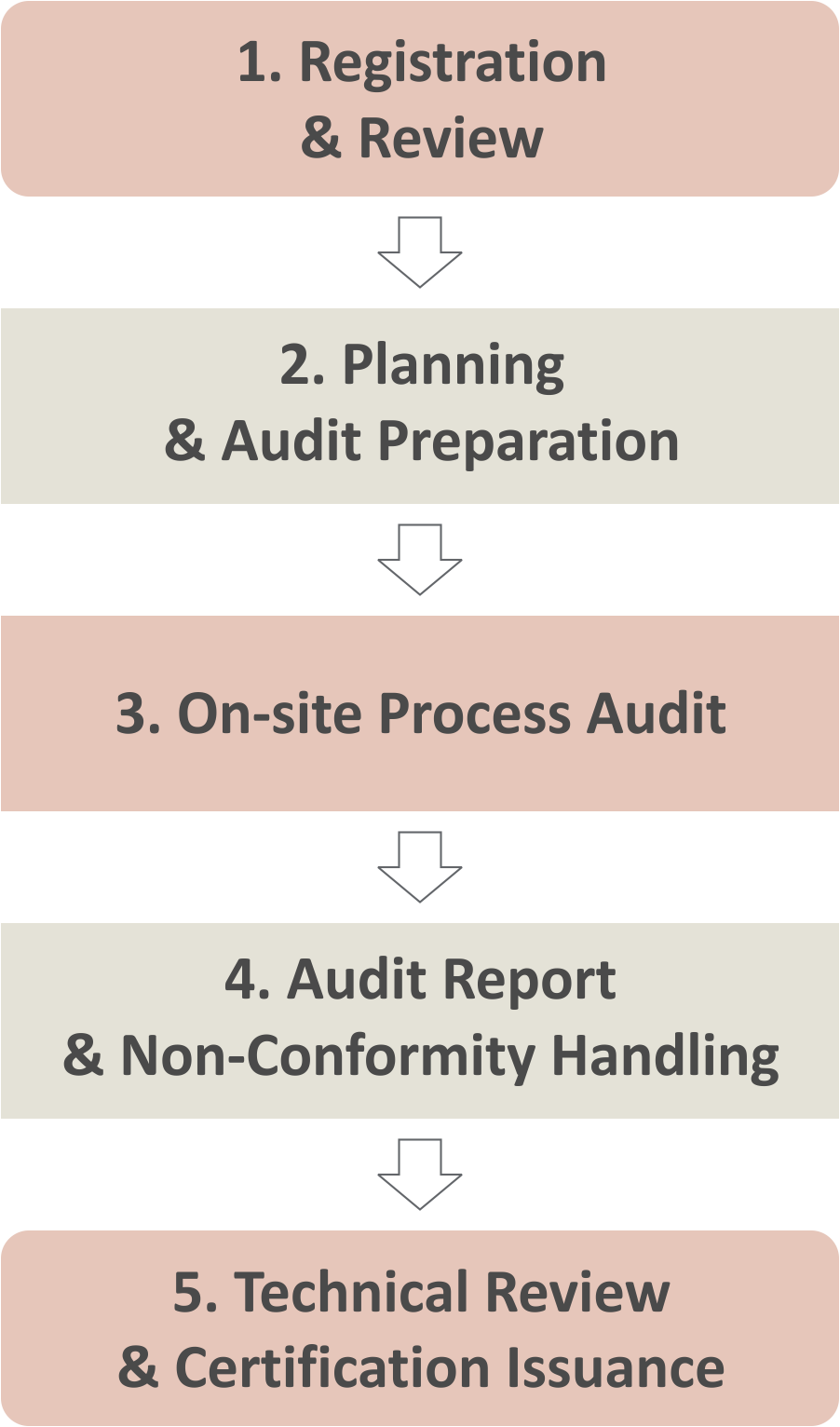 1. Registration & Application Review: The business contacts GIC Vietnam for guidance, completes the registration application, and provides the necessary documents regarding the traceability process. GIC Vietnam will review the completeness and suitability of the application for process certification.
2. Planning & Audit Preparation: GIC Vietnam establishes an audit program, identifying the necessary activities to verify that the business's traceability process meets the requirements of ISO 22005. Auditors are selected based on their competence and professional experience in the food/feed supply chain.
3. Audit Process: Direct evaluation of the conformity, effectiveness, and practical implementation of the traceability process at operational sites. The audit workflow includes: Opening Meeting → Practical audit of traceability steps and related documentation → Report Preparation → Closing Meeting.
4. Audit Report & Handling Non-conformities: Based on the audit results, the business implements corrective actions for any non-conformities (if applicable) to ensure full compliance with the standard's requirements.
5. Technical Review & Certification Issuance: The Certification Board reviews the entire audit file to make the final decision. The ISO 22005 process certificate is valid for 03 years, accompanied by periodic surveillance audit requirements (typically every 12 months) to maintain the validity of the certification.
III. WHY CHOOSE GIC VIETNAM?
+) International Reputation and Widespread Recognition: GIC is a reputable certification body, widely recognized through accreditation marks from leading organizations such as UKAS (UK), JASANZ (Australia - New Zealand), CPSC (USA), SAC (Singapore), CNAS (China), VICAS (Vietnam), etc. Certificates issued by GIC are globally recognized through the Multilateral Recognition Arrangements (MRA) of Global ACI (formerly IAF and ILAC) and regional accreditation cooperations like the Asia Pacific Accreditation Cooperation (APAC). This helps businesses minimize technical barriers, enhances the credibility of the certification, and facilitates easier access to international markets.
+) Professional, Objective, and Cost-Effective Services: GIC Vietnam provides services in accordance with stringent European and North American standards, ensuring independence, objectivity, and professionalism throughout the entire certification audit process. Alongside outstanding quality, GIC offers reasonable and competitive pricing, helping businesses utilize their investment resources effectively while still achieving internationally recognized certification.
CONTACT INFORMATION
GIC VIETNAM
🏢 Hà Nội: 12F, 14 Lang Ha Building, Giang Vo Ward
☎️ Tel: 024.6275 2268 | 📱Hotline: 0984609469
📧 Email: tuandm@gicvn.vn
🏢 Ho Chi Minh City: R502, 160 Nam Ky Khoi Nghia
☎️ Tel: 028.3930 7936