

ISO 14001:2026 Environmental Management System Certification
 ISO 14001:2026 is the international standard for Environmental Management Systems (EMS). Published by the International Organization for Standardization (ISO), it specifies the requirements for organizations to establish, implement, maintain, and continually improve an environmental management system. The core objective of the standard is to help enterprises systematically manage environmental aspects, fulfill compliance obligations, improve environmental performance, and achieve their set environmental objectives.
ISO 14001 was first published in 1996, and subsequently updated through the 2004, 2015 versions, and the latest being ISO 14001:2026. The 2026 version builds upon the foundation of ISO 14001:2015 but provides greater clarity to align with modern environmental priorities—particularly climate change, biodiversity, resource efficiency, risk management within the value chain, environmental data, and measurable performance results. ISO emphasizes that the 2026 version does not "redesign" the entire standard, but rather makes it clearer, easier to apply, and more tightly linked to practical outcomes.
ISO 14001:2026 is applicable to any organization, regardless of its size, sector, or geographical location. Manufacturing, commercial, service, logistics, construction, healthcare facilities, educational institutions, industrial zones, or public organizations can all implement this standard to control environmental impacts, enhance resource utilization, prevent pollution, and demonstrate responsibility to stakeholders.
Compared to ISO 14001:2015, the ISO 14001:2026 version places greater emphasis on several key areas:
- Comprehensive consideration of environmental conditions, including climate change, resources, ecosystems, and biodiversity;
- Clearer identification of the needs and expectations of interested parties regarding the environment, climate, supply chain, and data transparency;
- Management of environmental risks and opportunities linked to the operational context, compliance obligations, and environmental objectives;
- Enhanced control over outsourced processes, suppliers, and value chain activities related to environmental aspects;
- Increased focus on monitoring, measurement, analysis, and evaluation of environmental performance;
- Integration of audit findings, environmental data, and performance results into management reviews to drive improvement decisions.
Benefits of Implementing and Achieving ISO 14001:2026 Certification:
- Enhanced Control of Environmental Impacts: ISO 14001:2026 helps enterprises identify, assess, and control environmental aspects arising from their activities, products, and services. Through a systematic approach, businesses can more effectively manage the use of raw materials, energy, water, chemicals, waste, wastewater, emissions, noise, and other environmental impacts.
- Fulfillment of Environmental Compliance Obligations: The standard requires enterprises to determine, update, and evaluate their compliance with environment-related obligations. As a result, businesses have a framework to proactively monitor legal requirements, customer demands, contractual obligations, industrial park regulations, supply chain rules, or other environmental commitments.
- Improved Resource Efficiency and Operational Cost Savings: When environmental aspects are well-identified and controlled, enterprises can minimize material waste, save energy, reduce waste treatment costs, mitigate environmental incidents, and optimize operational efficiency. This delivers direct, tangible benefits for many manufacturing and service companies.
- Proactive Environmental Risk Management: ISO 14001:2026 continues to maintain a risk-and-opportunity-based approach. Instead of merely addressing issues after they occur, enterprises must proactively identify risks stemming from internal operations, legal requirements, climate change, environmental conditions, suppliers, outsourced processes, and stakeholder expectations.
- Increased Credibility with Customers, Investors, and Supply Chains: ISO 14001:2026 certification serves as independent proof that an enterprise has established and maintained an environmental management system according to international benchmarks. This provides a distinct advantage in tendering, partnering with major clients, participating in global supply chains, and accessing markets with stringent environmental and sustainable development requirements.
- Support for ESG and Sustainable Development Goals: While ISO 14001:2026 is not an ESG reporting standard itself, it provides a vital management foundation for environment-related ESG targets. The environmental management system equips enterprises with the data, accountability, control processes, and performance evidence needed for disclosures, customer and investor assessments, or sustainable development initiatives.
This service is suitable for:
- Enterprises building a brand-new environmental management system according to ISO 14001:2026;
- Enterprises currently implementing ISO 14001:2015 that need to transition to ISO 14001:2026;
- Enterprises requiring certification to meet customer demands, bidding requirements, export criteria, or supply chain benchmarks;
- Organizations aiming to improve environmental control, compliance obligations, and overall environmental performance;
- Enterprises seeking to integrate ISO 14001 with other management systems such as ISO 9001, ISO 45001, ISO 50001, or ESG frameworks.
II. CERTIFICATION PROCESS
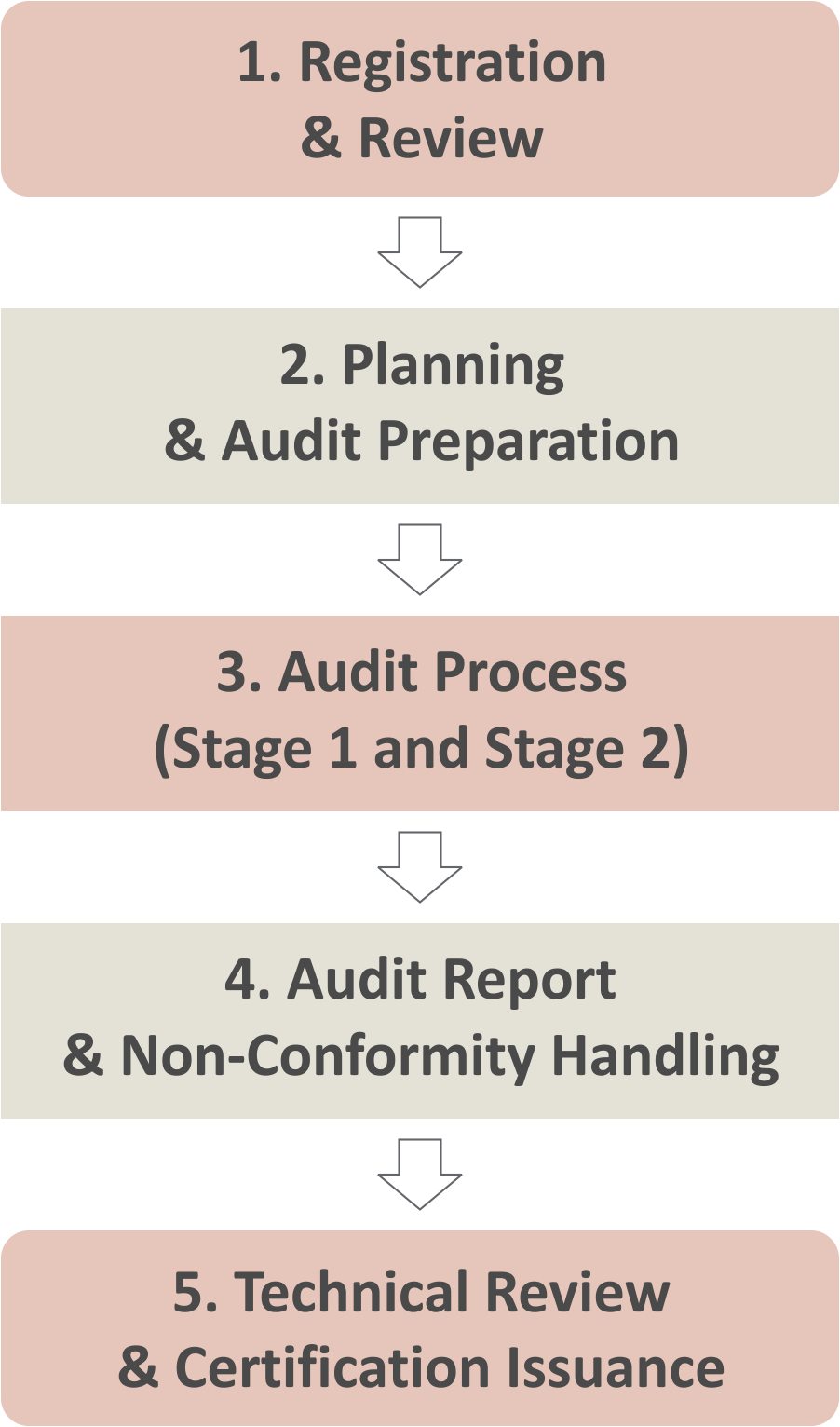 1. Application & Review: The enterprise contacts GIC Vietnam for guidance, completes the application form, and provides the necessary documentation required for ISO 14001:2026 certification. GIC Vietnam will conduct a review of the application's completeness and suitability.
2. Planning & Audit Preparation: GIC Vietnam establishes an audit program, defining the necessary activities to verify that the enterprise's Environmental Management System (EMS) meets the certification requirements. Auditors are selected based on competence and experience relevant to the enterprise's field of operation (including technical experts if necessary).
3. Audit Process: The process takes place in two stages:
- Stage 2: Evaluate the compliance, effectiveness, and practical implementation of the system at the operating sites. The audit procedure includes:
Opening Meeting → On-site Audit → Report Preparation → Closing Meeting
4. Audit Reporting & Non-conformity Handling: Based on the audit findings, the enterprise implements corrective actions for any non-conformities (if any) to ensure full compliance with the standard's requirements.
5. Technical Review & Certification Issuance: The Certification Board conducts a technical review of the entire audit file to make the final decision. The ISO 14001:2026 certificate is valid for 3 years, subject to periodic surveillance audits (typically once every 12 months) to maintain its validity.
III. WHY CHOOSE GIC VIETNAM?
+) International Reputation and Widespread Recognition: GIC is a prestigious and widely recognized certification body, backed by accreditation marks from leading bodies such as UKAS (UK), JASANZ (Australia - New Zealand), CPSC (USA), SAC (Singapore), CNAS (China), VICAS (Vietnam), among others. Certificates issued by GIC are recognized globally through the Multilateral Recognition Arrangements (MRA) of Global ACI (formerly IAF and ILAC) and regional accreditation cooperations such as the Asia Pacific Accreditation Cooperation (APAC). This helps enterprises minimize technical barriers, enhances the credibility of their certification, and facilitates smoother access to international markets.
+) Professional, Objective, and Cost-Effective Services: GIC Vietnam delivers services aligned with the stringent standards of Europe and North America, ensuring complete independence, objectivity, and professionalism throughout the certification audit process. Alongside exceptional quality, GIC offers reasonable and competitive costs, enabling enterprises to efficiently utilize their investment resources while achieving internationally recognized certification.
CONTACT INFORMATION
GIC VIETNAM
🏢 Hanoi Head Office: 12F, 14 Lang Ha Building, Giang Vo Ward
☎ Tel: 024 6275 2268 | Hotline: 0984 609 469
✉ Email: tuandm@gicvn.vn
🏢 Ho Chi Minh City Office: R502, 160 Nam Ky Khoi Nghia
☎ Tel: 028 3930 7936