

 Product Certification to Standards
I. INTRODUCTION TO PRODUCT CERTIFICATION SERVICES
Product certification to standards, also known as product conformance certification, is a third-party assessment activity aimed at confirming that a product meets the requirements specified in the standard selected as the basis for certification. The positive outcome is demonstrated by a decision and a certificate issued by the certification body; the use of the conformance mark is implemented according to the certification scheme and the guidelines of the certification body.
The standard used as the basis for certification can be a national standard (TCVN), an international standard (ISO, IEC...), a regional standard, a foreign standard, or other accepted standards, provided it is suitable for the product and falls within the competent scope of the certification body. The scope on the certificate is specifically defined by the product, product type or model, manufacturing facility, applicable standard, and certification scheme.
Conformance certification is carried out based on an agreement between the requesting organization or individual and the certification body, and is in principle a voluntary activity. However, a standard may become a mandatory requirement when cited in legal documents, technical regulations, contracts, bidding documents, or market demands. For products regulated by technical regulations, conformance certification does not replace technical regulation conformity certification, declaration of conformity, or other related legal obligations.
Benefits for Businesses
There is no one-size-fits-all scheme for every product. The certification body (GIC Vietnam) determines the certification scheme based on the applicable standard, the product's characteristics and risk level, production method, certification purpose, legal requirements, and rules of the certification program. Audit activities may include reviewing technical documents, sampling and testing, auditing the production process and quality control system, along with post-certification surveillance activities.
For continuously manufactured products, Scheme 5 is often applied, which includes type testing, production process assessment, and periodic surveillance through testing samples taken at the production site or on the market combined with production process assessment. For product batches, single products, or specific cases, other schemes may be more suitable. The scheme, sampling rules, audit scope, and surveillance frequency are confirmed during the application review stage.
Distinctions to Note
+) Conformance certification vs. Declaration of conformity: Conformance certification is a third-party confirmation; declaration of conformity is the public declaration by an organization or individual that an object conforms to a corresponding standard. The declaration can be based on certification results or self-assessment results as prescribed. In the case of self-declaration based on self-assessment, the organization or individual is not allowed to use the conformance mark.
+) Standard conformance vs. Technical regulation conformity: Standard conformance is based on standards and is generally voluntary; technical regulation conformity is based on technical regulations and is a mandatory requirement for objects within the applicable scope of the respective regulation.
II. CERTIFICATION PROCESS
Product certification to standards, also known as product conformance certification, is a third-party assessment activity aimed at confirming that a product meets the requirements specified in the standard selected as the basis for certification. The positive outcome is demonstrated by a decision and a certificate issued by the certification body; the use of the conformance mark is implemented according to the certification scheme and the guidelines of the certification body.
The standard used as the basis for certification can be a national standard (TCVN), an international standard (ISO, IEC...), a regional standard, a foreign standard, or other accepted standards, provided it is suitable for the product and falls within the competent scope of the certification body. The scope on the certificate is specifically defined by the product, product type or model, manufacturing facility, applicable standard, and certification scheme.
Conformance certification is carried out based on an agreement between the requesting organization or individual and the certification body, and is in principle a voluntary activity. However, a standard may become a mandatory requirement when cited in legal documents, technical regulations, contracts, bidding documents, or market demands. For products regulated by technical regulations, conformance certification does not replace technical regulation conformity certification, declaration of conformity, or other related legal obligations.
Benefits for Businesses
- Provide objective evidence: Independent testing and audit results help prove that the product meets standard requirements, thereby strengthening the trust of customers, partners, and buyers.
- Support quality control: The certification process helps businesses identify characteristics that need controlling, non-conformities, and risks that may affect the ability to maintain consistent quality.
- Enhance market access capabilities: The certificate can support product promotion, supplier selection, procurement, bidding, or export activities when the standard and certification results are accepted by the receiving party.
- Use of the conformance mark: Certified products can use the conformance mark in accordance with the certification body's regulations during the validity period of the certification, thereby helping customers recognize and trace the certification basis.
There is no one-size-fits-all scheme for every product. The certification body (GIC Vietnam) determines the certification scheme based on the applicable standard, the product's characteristics and risk level, production method, certification purpose, legal requirements, and rules of the certification program. Audit activities may include reviewing technical documents, sampling and testing, auditing the production process and quality control system, along with post-certification surveillance activities.
For continuously manufactured products, Scheme 5 is often applied, which includes type testing, production process assessment, and periodic surveillance through testing samples taken at the production site or on the market combined with production process assessment. For product batches, single products, or specific cases, other schemes may be more suitable. The scheme, sampling rules, audit scope, and surveillance frequency are confirmed during the application review stage.
Distinctions to Note
+) Conformance certification vs. Declaration of conformity: Conformance certification is a third-party confirmation; declaration of conformity is the public declaration by an organization or individual that an object conforms to a corresponding standard. The declaration can be based on certification results or self-assessment results as prescribed. In the case of self-declaration based on self-assessment, the organization or individual is not allowed to use the conformance mark.
+) Standard conformance vs. Technical regulation conformity: Standard conformance is based on standards and is generally voluntary; technical regulation conformity is based on technical regulations and is a mandatory requirement for objects within the applicable scope of the respective regulation.
II. CERTIFICATION PROCESS
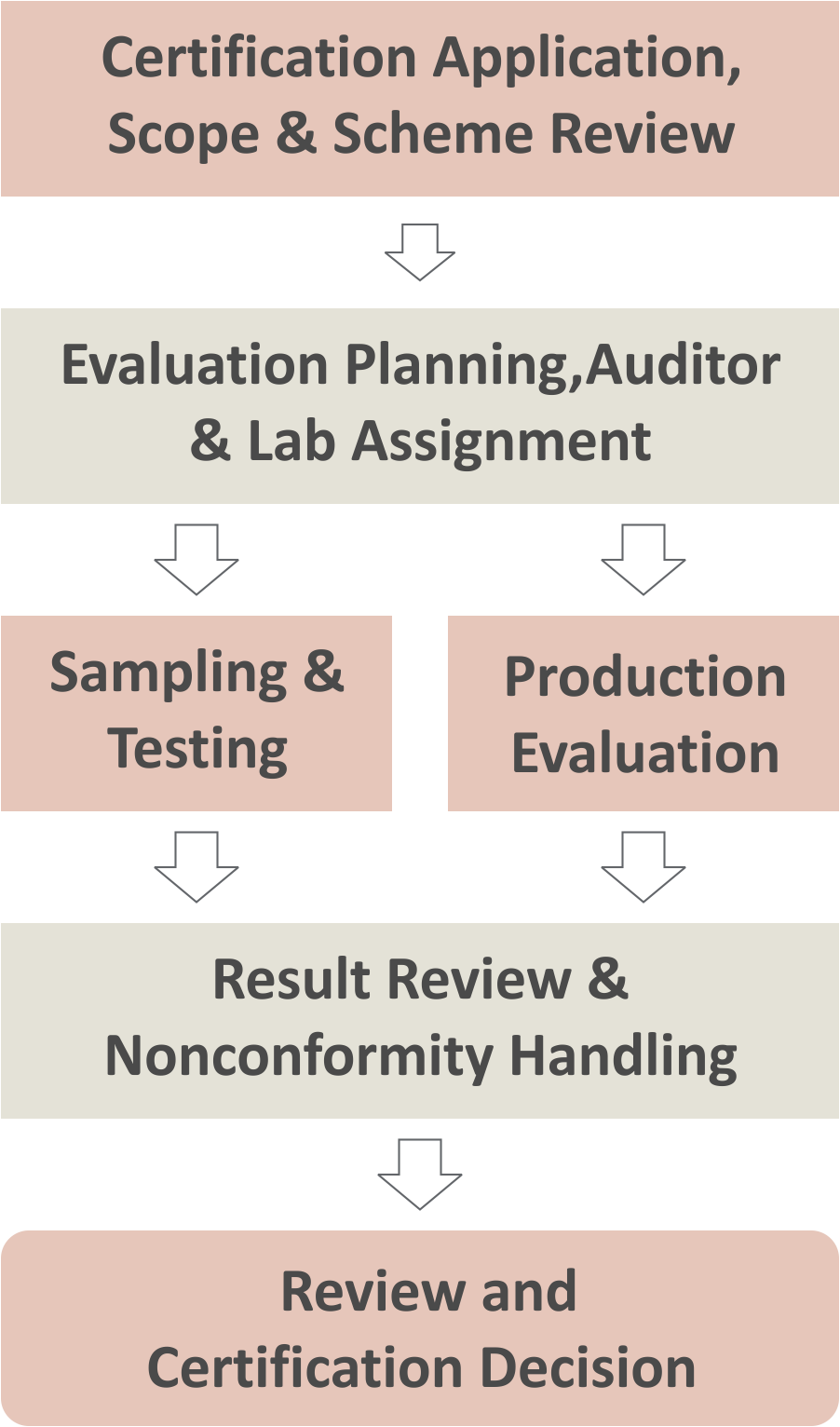 Depending on the product and certification scheme, detailed contents may be adjusted; GIC Vietnam's standard-compliant product certification process consists of the following main steps:
1. Certification application, scope and scheme review: The customer submits an application along with information about the product, applicable standard, manufacturing facility, and related technical documents. GIC Vietnam reviews the completeness of the information, confirms the requested scope, certification basis, applied scheme, implementation capability, and conditions of the certification service.
2. Audit planning, assignment of experts and testing laboratories: Based on the accepted request, GIC Vietnam establishes an audit plan; assigns auditors and technical experts with appropriate competence; determines the sampling and testing plan, and selects a testing laboratory that meets the requirements. The plan and preparation requirements are communicated to the customer prior to implementation.
3. Sampling, testing, and production process audit: Representative samples are taken, identified, preserved, and transferred for testing according to the certification program's regulations. Simultaneously, the audit team reviews the production process and quality assurance conditions, including input materials, critical control steps, internal inspection, measuring equipment, handling of non-conforming products, and traceability. The level of application of each activity depends on the certification scheme.
4. Result synthesis, non-conformity handling: GIC Vietnam synthesizes the testing and production audit results to determine the level of compliance with certification requirements. If there are non-conformities, the customer analyzes the causes, implements corrective actions, and provides evidence. GIC Vietnam reviews and verifies; re-testing or supplementary audits are conducted when necessary.
5. Review and certification decision: The dossier is reviewed by a competent person or group of persons, independent of the audit activity, before a decision is made. When the requirements are met, GIC Vietnam issues a certificate specifying the product, standard, scope, manufacturing facility, and related validity conditions. In case of insufficient grounds for certification, the customer is notified of the decision and the reasons. The validity, surveillance content, and re-certification are determined according to the applied certification scheme and program.
III. WHY CHOOSE GIC VIỆT NAM?
+) Accreditation network and international experience: Within the GIC network, conformity assessment competence is accredited or approved by reputable organizations such as UKAS, JAS-ANZ, SAAS, SAC, CNAS, CPSC, and BoA/VICAS, depending on the specific legal entity, country, field, and scope. GIC Vietnam can mobilize its expert network and implementation experience across multiple markets to select suitable assessment schemes, supporting businesses in proving their product quality reliably.
+) Increased international market acceptance: For certificates issued within the corresponding accreditation scope and bearing the appropriate accreditation mark, the multilateral recognition arrangements of the Global Accreditation Cooperation Incorporated (Global ACI, the successor organization to IAF and ILAC) and regional accreditation agreements like APAC support the acceptance of conformity assessment results among member economies. This forms the basis for enhancing credibility, limiting unnecessary repetitive audits, and facilitating businesses' access to supply chains, partners, and international markets. The actual level of acceptance depends on the standard, certification program, and specific market requirements.
+) Technical competence, objectivity, and cost-efficiency: GIC Vietnam's product certification activities are established and controlled in accordance with ISO/IEC 17065, the certification program, and relevant legal requirements, within the valid scope of registration, accreditation, or approval. Experts are assigned based on product categories; the audit, review, and certification decision activities are independently controlled to ensure objectivity. The process is organized transparently, confidentially, and rationally, helping to limit unnecessary time and costs without compromising the reliability of the certification results.
CONTACT INFORMATION
GIC VIETNAM
🏢 Hanoi Head Office: 12F, 14 Lang Ha Building, Giang Vo Ward
☎ Tel: 024 6275 2268 | Hotline: 0984 609 469
✉ Email: tuandm@gicvn.vn
🏢 Ho Chi Minh City Office: R502, 160 Nam Ky Khoi Nghia
☎ Tel: 028 3930 7936